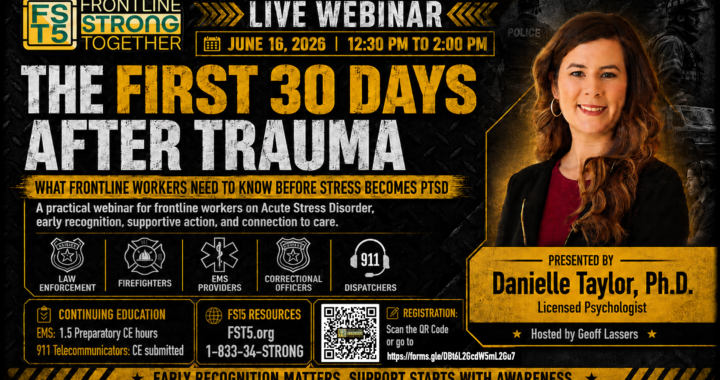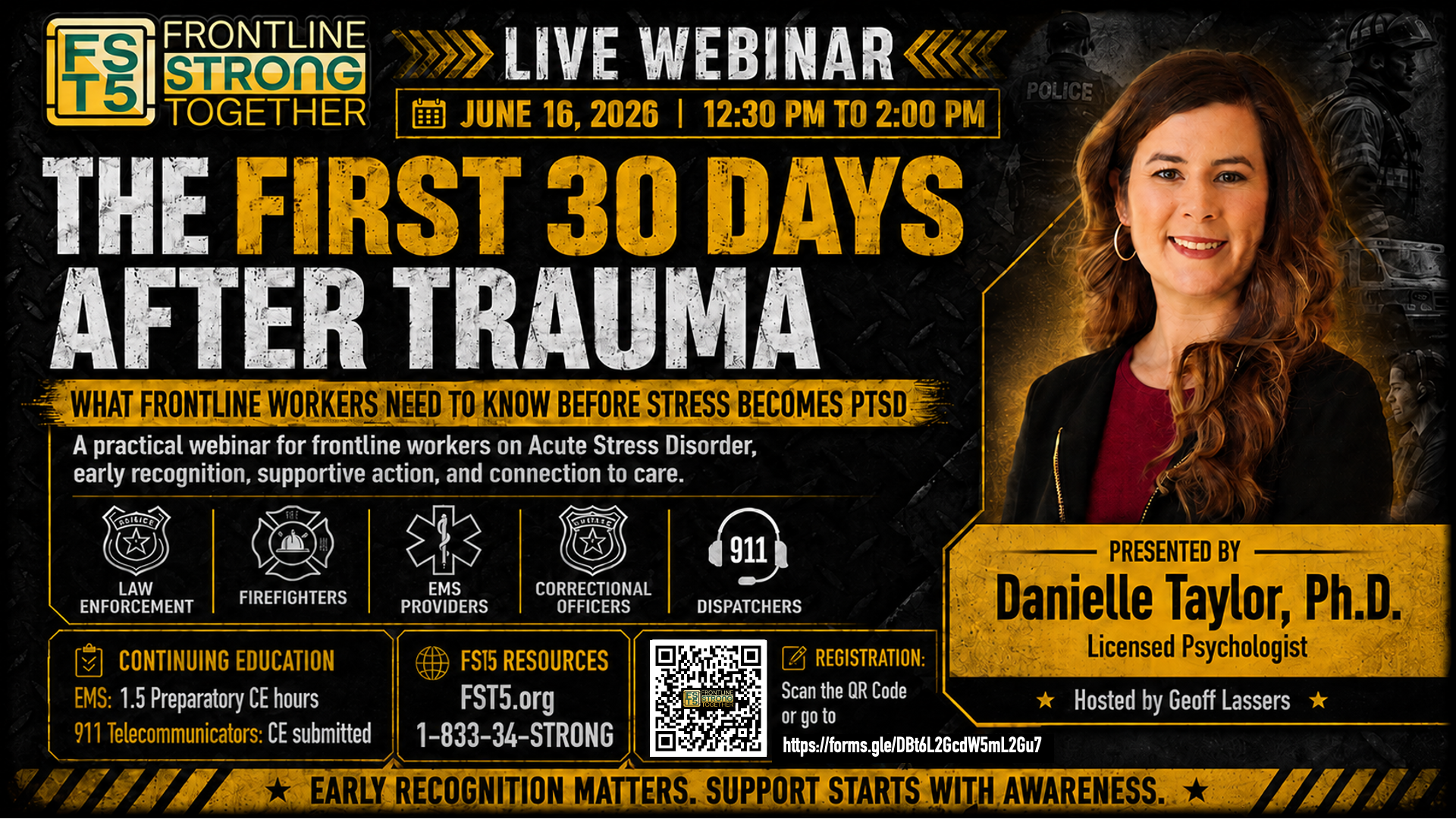
The First 30 Days After Trauma: What Frontline Workers Need to Know Before Stress Becomes PTSD (June 16, 2026, from 12:30 PM to 2:00 PM) Registration is Open.

๐Ÿ“… June 16, 2026
โฐ 12:30 PM to 2:00 PM


What this webinar is about:

The first 30 days after a traumatic event can change everything. This free live webinar gives first responders the practical knowledge to recognize Acute Stress Disorder (ASD) early โ€” in themselves and the people next to them โ€” and understand what support looks like before stress becomes something harder to carry.

Who This Is For Law enforcement officers, firefighters, EMS providers, correctional officers, and 911 dispatchers across Michigan.

What You’ll Learn

  • What Acute Stress Disorder is and how it develops after trauma
  • Key symptoms to recognize โ€” in yourself and your team
  • The difference between ASD and PTSD and why timing matters
  • Practical frontline-level support actions
  • Confidential resources available to you right now

Presented by Danielle Taylor, Ph.D. Licensed Psychologist | Assistant Professor, Wayne State University School of Medicine | Clinical Therapist, Wayne Health Psychiatry Hosted by Geoff Lassers

Continuing Education (CE) – This webinar is approved for the following:

  • EMS: 1.5 Preparatory CE Credit. Approved by the MDHHS BETP (approval number: 26-ICE-17729)
  • 911 Telecommunications:ย ย 1 CE Credit Approved by MiSNAP (approval number: FST2026- 6474).

The FST5 Program is diligently working toward continuing education credits for law enforcement, corrections, and the fire service.
Learning objectives:

By the end of this session, participants will be able to:

1. Define Acute Stress Disorder and describe its development after trauma.

2. Identify key symptoms and behavioral changes associated with ASD and PTSD.

3. Compare and contrast ASD with PTSD and other trauma reactions.

4. List and describe practical frontline-level support actions that may help individuals in the early phase of trauma response.

5. List clinical and organizational resources for assessment and care.

What to Expect When You Call the FST5 Support Line

A lot of first responders hesitate to call because they don’t know what happens next. Here’s what you can actually expect.

Who answers the phone The FST5 line is staffed by first responders with at least 10 years in the field. They understand the culture, the job, and the weight that comes with it. You won’t have to explain yourself.

You stay in control You decide what you share and how far the conversation goes. Nothing is set in motion without you. You can start, stop, or step back at any point.

Your privacy is fully protected Nothing is reported to your department. The State of Michigan cannot see who calls. Your anonymity is protected from start to finish โ€” no exceptions.

No reason is too small Bad shift. Trouble at home. Financial stress. Just needing someone to listen. There is no wrong reason to call. Family members can call too.

You won’t be handed off and forgotten FST5 stays with you through the process โ€” connecting you with resources, clinicians, and support every step of the way.

1-833-34-STRONG (1-833-347-8766)

Finding the Right Mental Health Provider

Getting matched with the right clinician starts with a simple intake form โ€” covering your location, whether you prefer in-person or telehealth, your therapy preferences, and more. From there, FST5 connects you with a culturally competent provider who understands first responder culture, so you spend less time explaining and more time actually talking.

The first few sessions are about building rapport and getting to know your story โ€” not quick fixes. And if the connection isn’t there? That’s okay. You can always reach back out to FST5 and request a different clinician. No hurt feelings. No judgment. Just finding what works for you.

EMS Week

EMS Week 2026

EMS Week

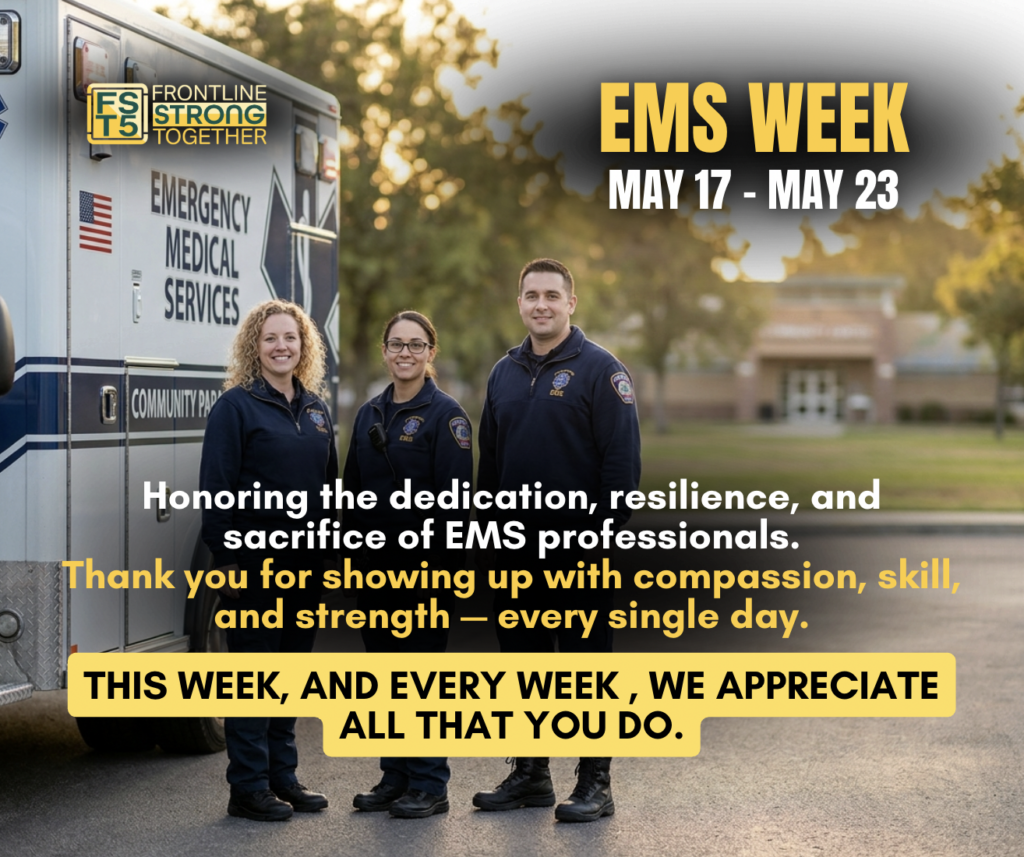
This EMS Week, we recognize the strength, compassion, and commitment of EMS professionals across Michigan and beyond.

Thank you for answering the call, showing up in difficult moments, and continuing to care for your communities every day.

To those who keep order where itโ€™s hardest to hold – thank you.
At FST5, support is built for you:

Confidential 24/7 resource line
Peer support from people who understand the job
Clinicians experienced in working with first responders
You donโ€™t have to wait until something feels โ€œseriousโ€ to reach out.
โ€”
FST5 Program. Supporting the wellness of Michiganโ€™s first responders and their families.
In crisis or in need of resources call 1-833-34-STRONG (1-833-347-8766

National Police Week 2026

This National Police Week, we honor the officers who continue to serve their communities every day โ€” and remember those who gave their lives in the line of duty.

We also recognize the families, partners, peers, and departments who carry the weight of this profession alongside them.

Thank you for your service and sacrifice.

To those who keep order where itโ€™s hardest to hold – thank you.
At FST5, support is built for you:

Confidential 24/7 resource line
Peer support from people who understand the job
Clinicians experienced in working with first responders
You donโ€™t have to wait until something feels โ€œseriousโ€ to reach out.
โ€”
FST5 Program. Supporting the wellness of Michiganโ€™s first responders and their families.
In crisis or in need of resources call 1-833-34-STRONG (1-833-347-8766

National Correctional Officer’s Week

Correctional officers work in one of the most demanding and least understood environments in public safety.

Long shifts. Constant vigilance. Pressure most people never see.

This week, we recognize the role you carry – and the weight that comes with it.

To those who keep order where itโ€™s hardest to hold – thank you.
At FST5, support is built for you:

Confidential 24/7 resource line
Peer support from people who understand the job
Clinicians experienced in working with first responders
You donโ€™t have to wait until something feels โ€œseriousโ€ to reach out.
โ€”
FST5 Program. Supporting the wellness of Michiganโ€™s first responders and their families.
In crisis or in need of resources call 1-833-34-STRONG (1-833-347-8766

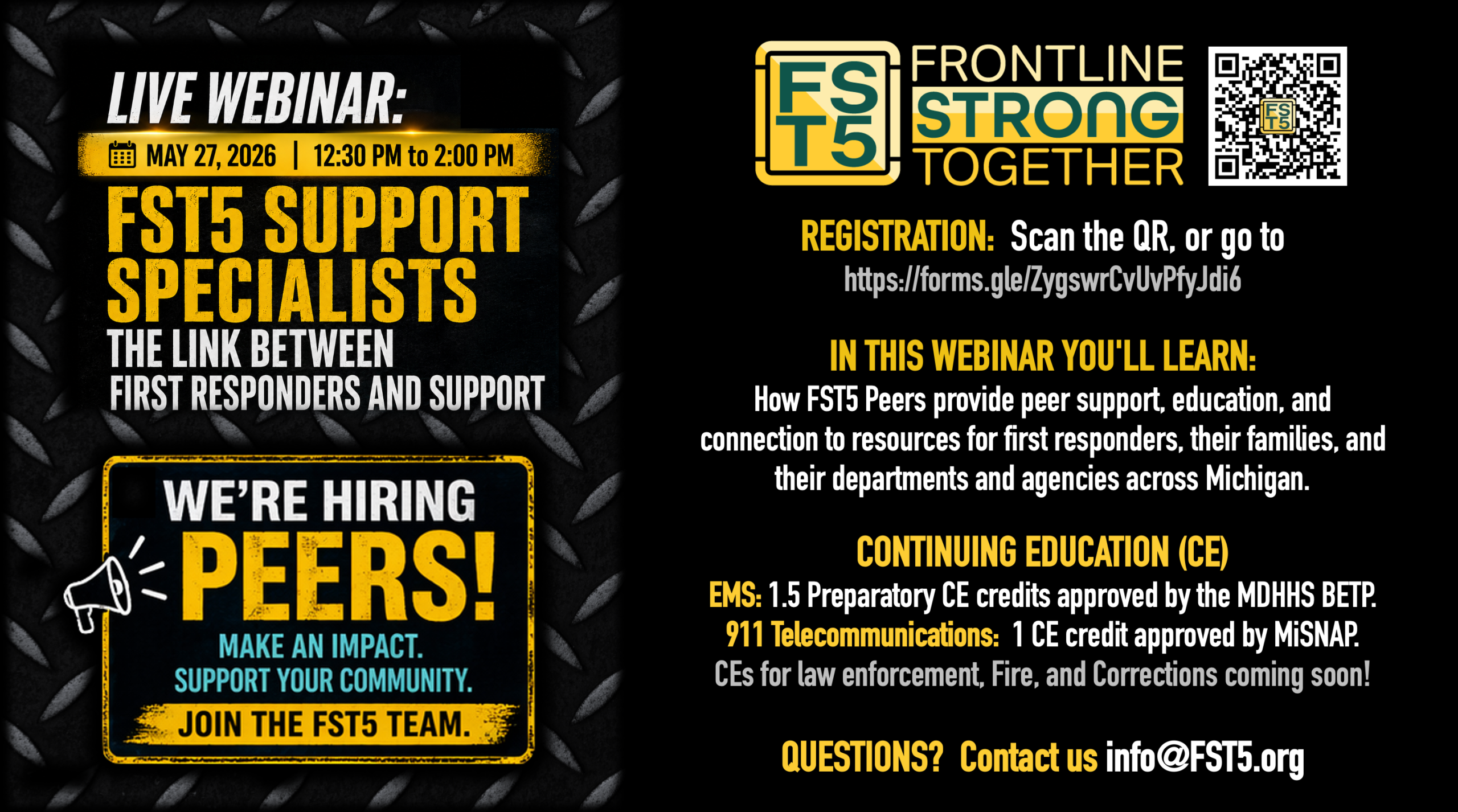
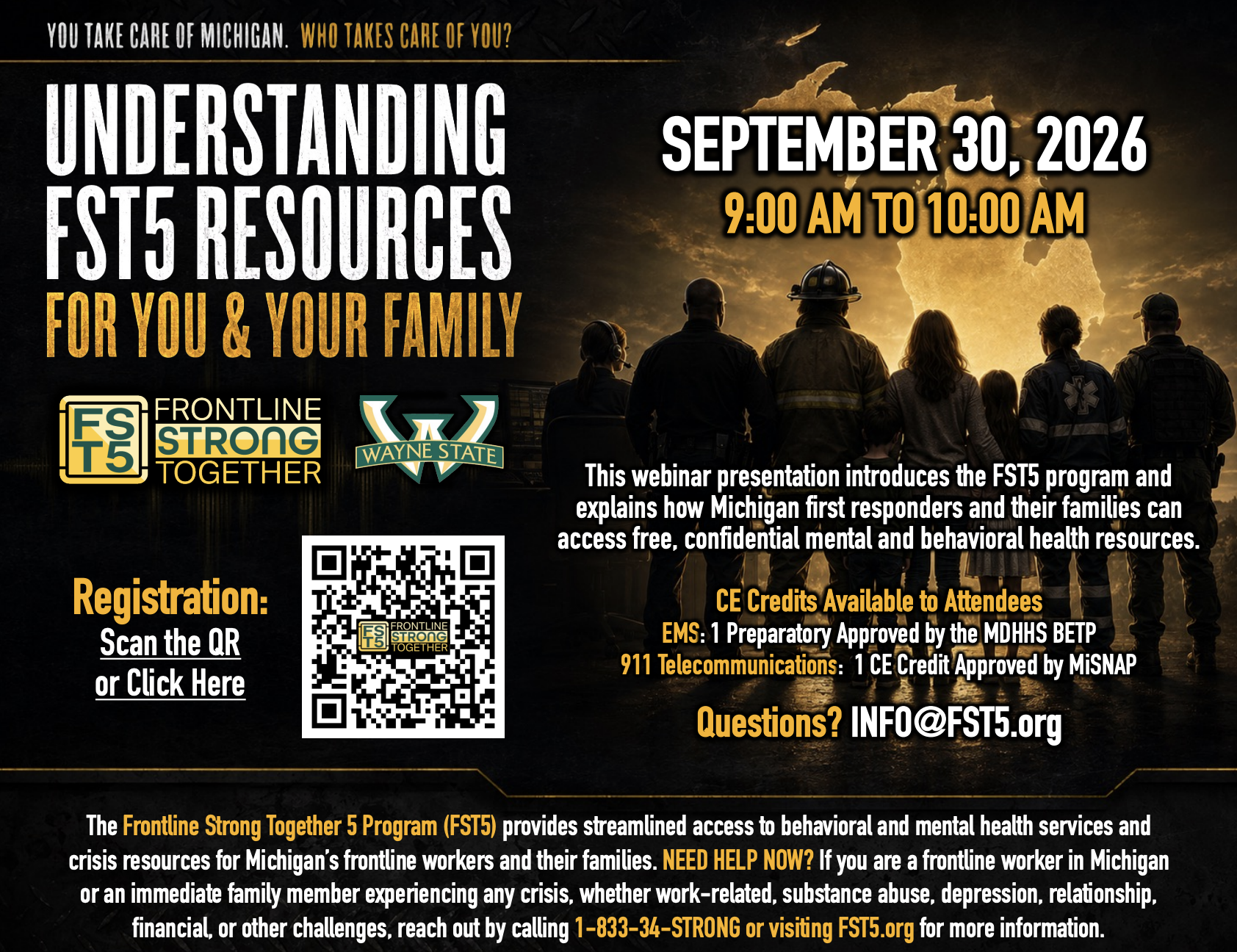
FST5 Support Specialists: The Link between First Responders and Support (May 27, 2026, from 12:30 PM to 2:00 PM)

๐Ÿ“… May 27, 2026
โฐ 12:30 PM to 2:00 PM


What this webinar is about

Thisย webinarย provides a clear overview of the role and value of FST5 Support Specialists within the Frontline Strong Together 5 (FST5) Program, helping participants understand what an FST5 Support Specialists is and how they support Michiganโ€™s first responders, their families, and their departments.

The session highlights how FST5 Support Specialists function as trained peer supporters, educators, resource navigators, and ambassadors,ย connectingย individuals and organizations to resources, education, and clinical care. The course also outlines the qualifications, expectations, and responsibilities of the role, as the FST5 Program is activelyย seekingย to recruit and hireย additionalย peers across Michigan to support continued program growth and meet the needs of the frontline community.

Continuing Education (CE) – This webinar is approved for the following:

  • EMS: 1.5 Preparatory CE Credit. Approved by the MDHHS BETP (approval number: 26-ICE-17087)
  • 911 Telecommunications:  1 CE Credit Approved by MiSNAP.

The FST5 Program is diligently working toward continuing education credits for law enforcement, corrections, and the fire service.
Presenters:

Geoff Lassers (1480924) will serve as host and moderator.  The applicable information will be presented by subject-matter experts from the Frontline Strong Together 5 Program, including:   

Scott Taylor, FST5 Lead Support Specialist, Retired Law Enforcement 

Ryan Fessenden, FST5 Administrative Coordinator, Retired 911 Dispatcher 

Learning objectives:

By the end of this session, participants will be able to: 

  • Describe the role, purpose, and value of an FST5 Peer within the Frontline Strong Together 5 (FST5) Program. 
  • Explain how FST5 Peers support first responders and their families. 
  • Explain how to access and effectively utilize an FST5 Peer. 
  • Describe how FST5 Peers support departments and agencies. 
  • Identify the expectations, qualifications, and process for becoming and serving as an FST5 Peer. 

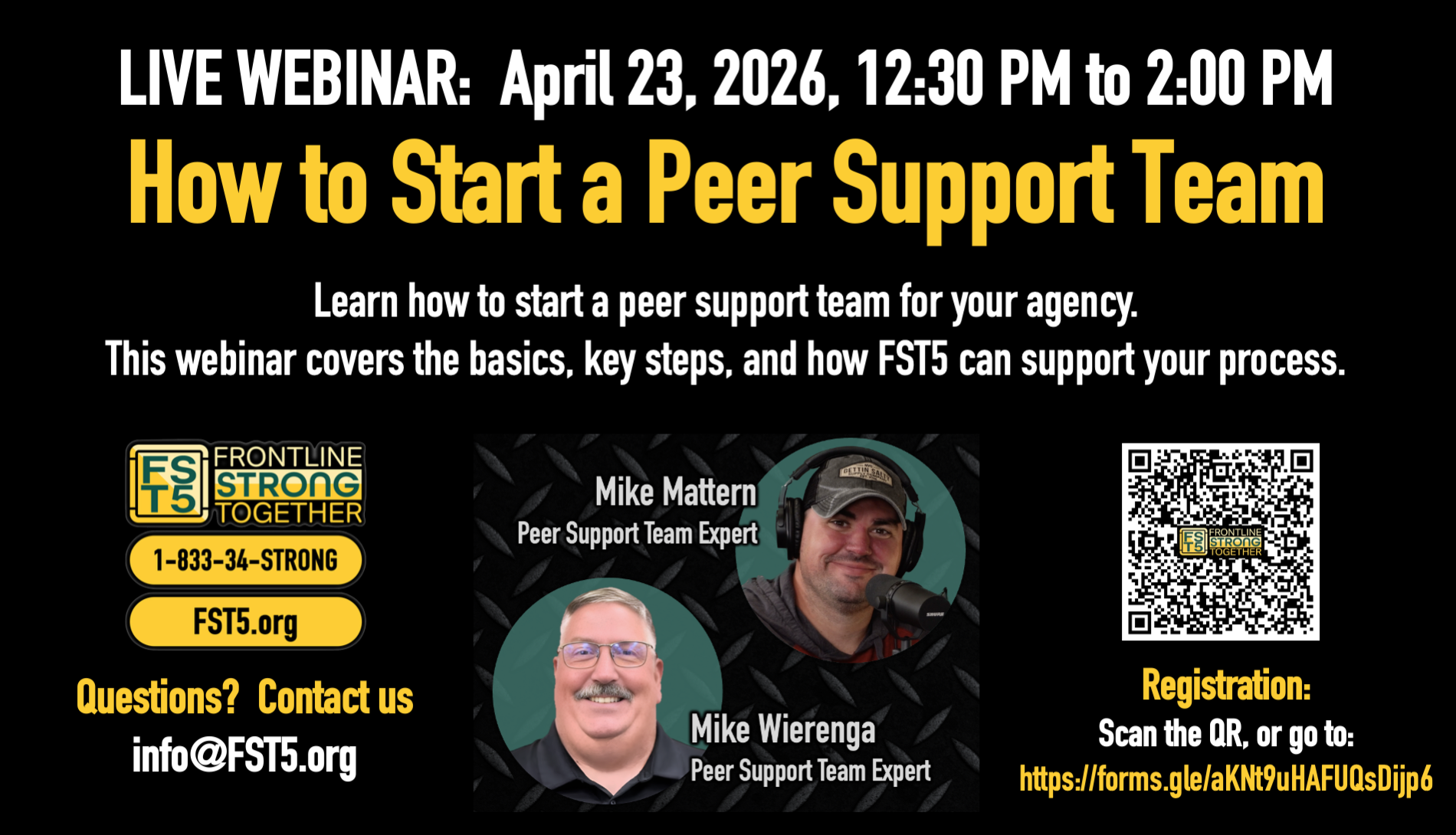
How to Start a Peer Support Team (April 23, 2026, from 12:30 PM to 2:00 PM) Registration Closed


๐Ÿ“… April 23, 2026
โฐ 12:30 PM to 2:00 PM


What this webinar is about

This webinar provides a clear, practical guide for first responder agencies to
understand, build, and implement effective peer support teams,
with support from the Frontline Strong Together 5 Program.

Continuing Education (CE) – This webinar is approved for the following:

  • EMS: 1.5 Preparatory CE Credit. Approved by the MDHHS BETP (approval number: 26-ICE-17087)
  • 911 Telecommunications: 1 CE Credit Approved by MiSNAP (approval number: FST2026-6319)

The FST5 Program is diligently working toward continuing education credits for law enforcement, corrections, and the fire service.
Presenters:

Mike Mattern โ€” Firefighter-paramedic, EMS I/C and peer support team expert; Mike Wierenga โ€” Retired law enforcement officer and co-founder of 2 the Rescue; Jim Peyton โ€” Former Firefighter-Paramedic, FST5 Call Center Manager; Scott Taylor โ€” FST5 Lead Support Specialist, Retired Law Enforcement; Ryan Fessenden โ€” FST5 Administrative Coordinator, Retired 911 Dispatcher; Geoff Lassers โ€” Firefighter-paramedic, EMS I/C and content creator.

Learning objectives:

  • Provide an overview of what Frontline Strong Together (FST5) is, including why it was
    created and the mental and behavioral health needs it was designed to address for
    Michigan first responders and their families.
  • Describe what a peer support team is and the role it plays in supporting first responders.
  • Differentiate peer support teams from Critical Incident Stress Management (CISM) teams.
  • Describe how peer support teams and CISM teams complement one another.
  • Describe the role of confidentiality in peer support programs.
  • Identify the training required for peer support team members.
  • Describe how departments can select peer support team members and collaborate with
    clinicians.
  • Appreciate the importance of self-care for peer support team members.
  • Describe how agencies can introduce and implement a peer support team within their
    department.
    Continuing Education (CE) – This webinar is approved for the following:
  • EMS: 1.5 Preparatory CE Credit. Approved by the MDHHS BETP (approval number: 26-ICE-17087)
  • 911 Telecommunications: 1 CE Credit Approved by MiSNAP (approval number: FST2026-6319)
  • The FST5 Program is diligently working toward continuing education credits for law enforcement,
    corrections, and the fire service.
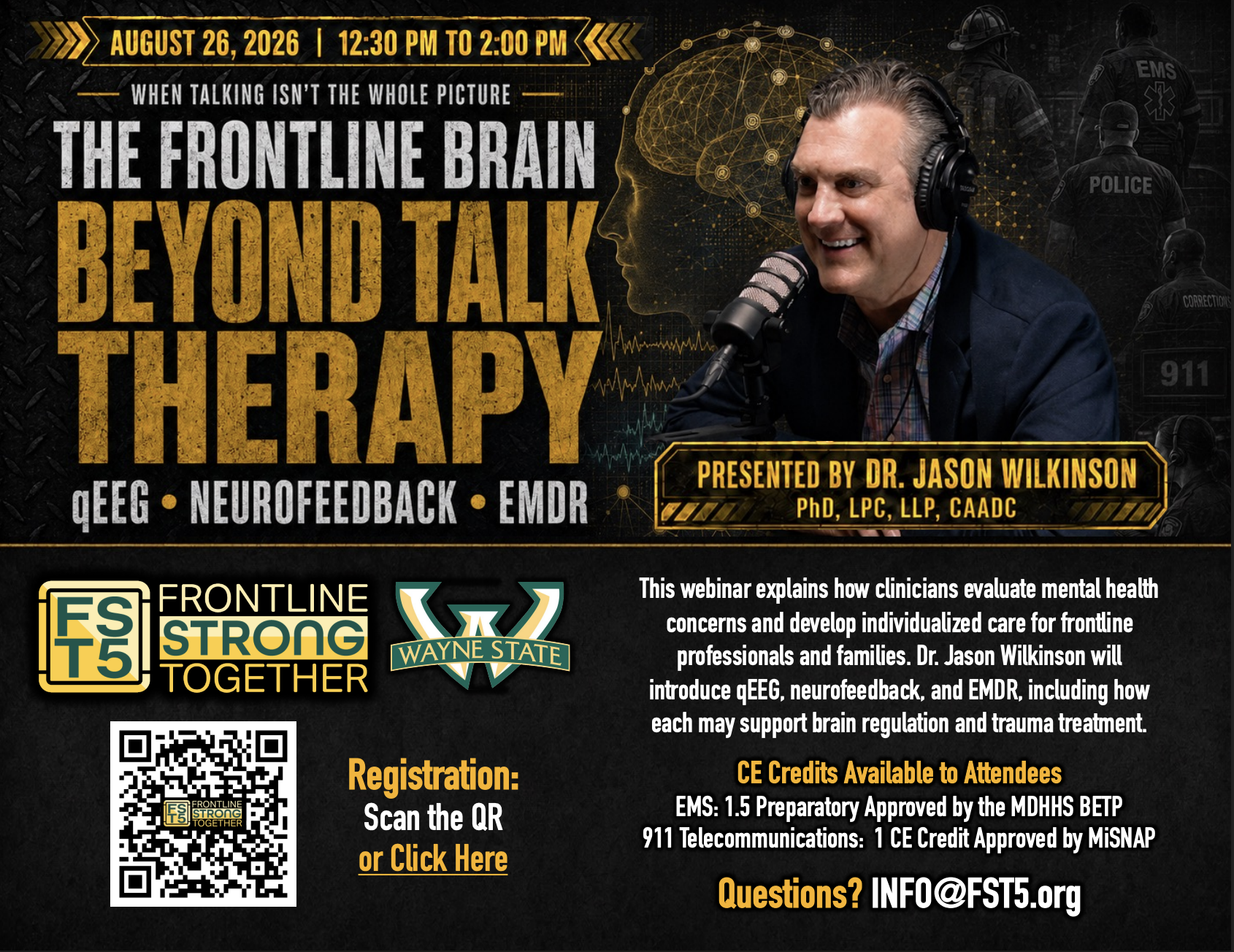
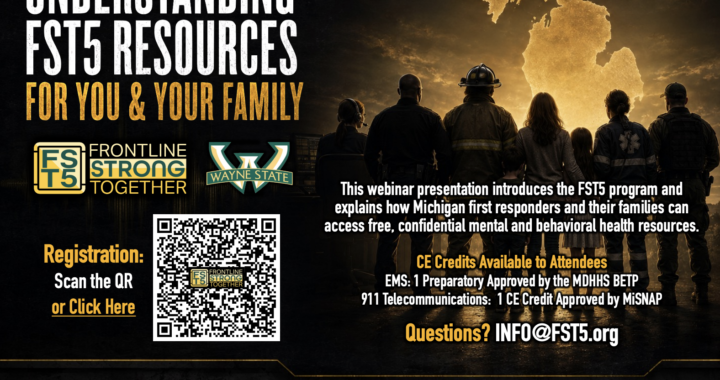
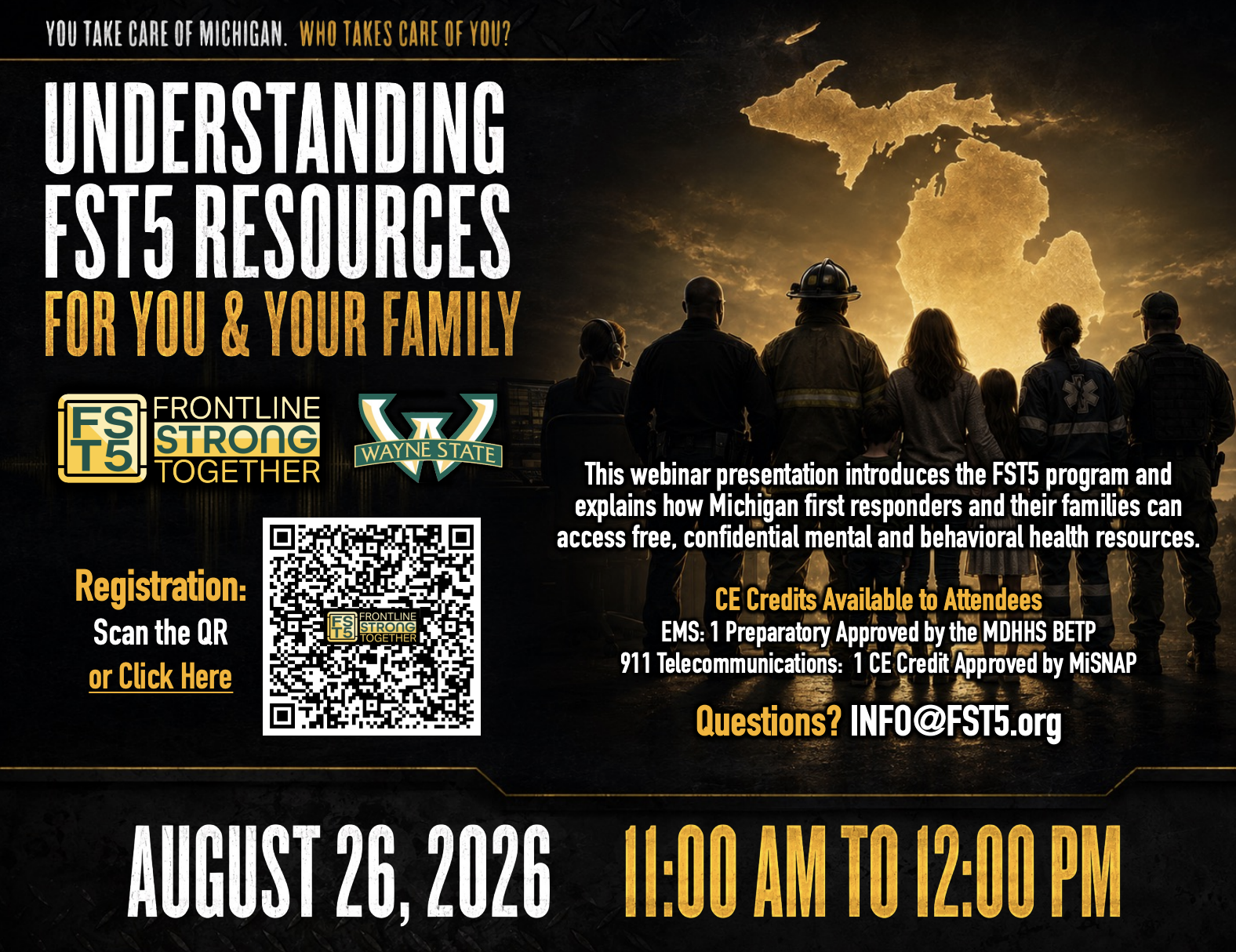
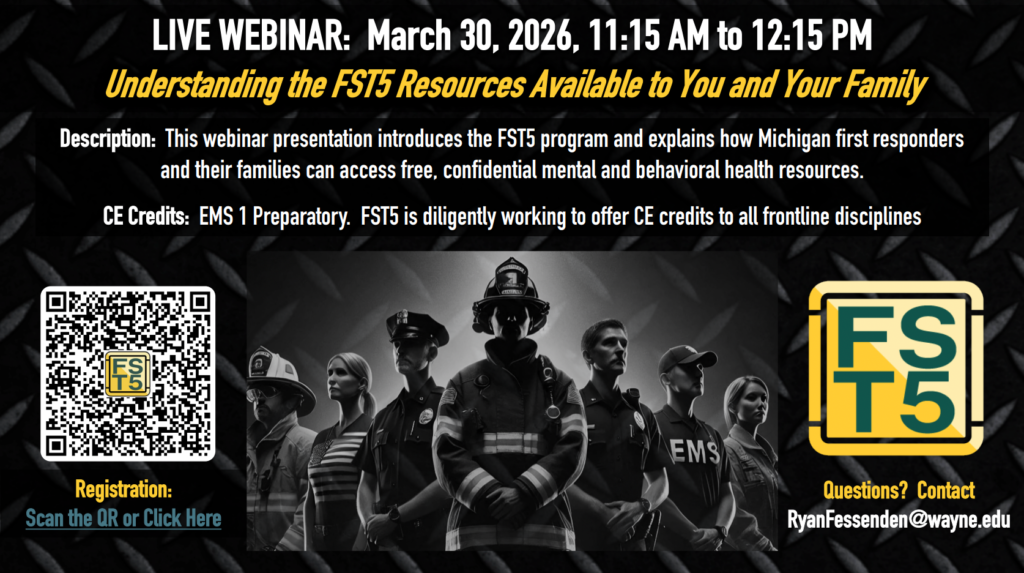
Understanding FST5 Resources Available to You and Your Family. (March 30, 2026, 11:15 AM – 12:15 PM) Registration Closed


๐Ÿ“… March 30, 2026
โฐ 11:15 AM -12:15 PM


What this webinar is about

This session gives a clear overview of the mental health, peer support, and wellness resources available through FST5 for first responders and their families. Learn how to access services, what to expect, and how departments can connect members to support.

Continuing Education (CE) Credits: 

Approved for 1 Preparatory EMS CE credit through the MDHHS BETP. 

Approved for 1 Dispatch Continuing Education (CE) credit.

CE credits are NOT currently approved for Fire, Law Enforcement, or Corrections. FST5 is actively working to expand CE approval to all frontline disciplines for future events.