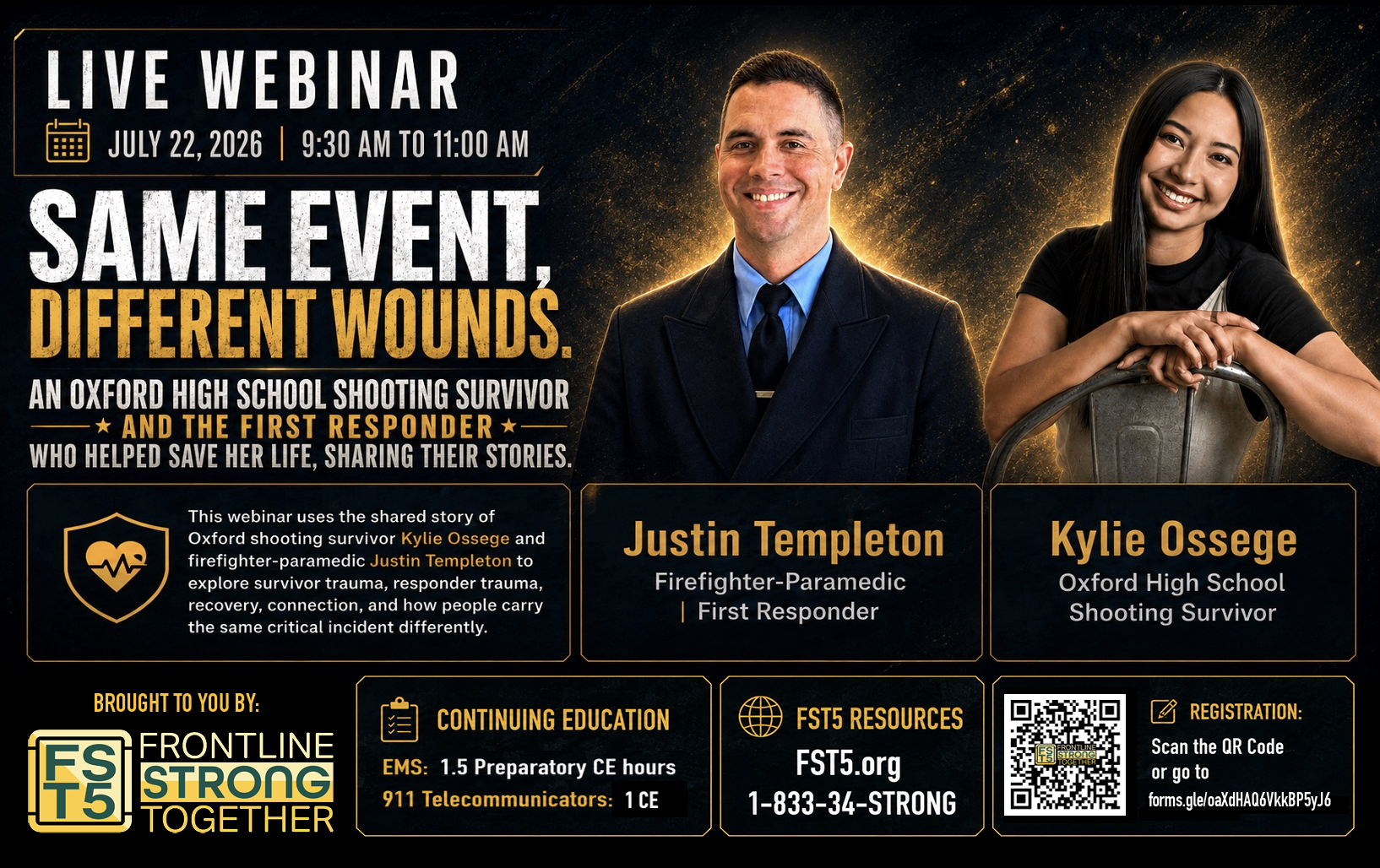
Same event. Two completely different experiences of it. On July 22, Oxford High School shooting survivor Kylie Ossege and the firefighter-paramedic who treated her, Justin Templeton, share their perspectives from that day — and the years since. FST5 clinicians unpack why trauma hits survivors, responders, and families so differently, and what actually helps afterward.
📅 July 22, 2026
⏰ 9:30 AM to 11:00 AM
What this webinar is about:
This webinar uses the lived experiences of Oxford High School shooting survivor Kylie Ossege and firefighter-paramedic Justin Templeton to explore how the same traumatic event can affect survivors, responders, families, and frontline workers in different ways. Justin and Kylie will share their perspectives from the incident and the years that followed, while FST5 clinicians provide an evidence-informed clinical lens on trauma exposure, survival responses, memory, emotional processing, responder compartmentalization, uncertainty, closure, meaning, connection, and recovery. The intent is not to clinically analyze or diagnose Justin or Kylie, but to help frontline workers better understand normal human responses to abnormal events and identify practical ways to support themselves, their peers, survivors, families, and communities after critical incidents.
Who This Is For: Law enforcement officers, firefighters, EMS providers, correctional officers, and 911 dispatchers across Michigan.
What You’ll Learn. By the end of this session, participants will be able to:
- Recognize common trauma responses like fight, flight, freeze, and memory gaps
- Tell the difference between in-the-moment survival reactions and delayed reactions that hit later
- Understand that the same event can affect survivors, responders, and families differently
- Identify what makes post-incident processing harder for responders, like triage decisions and lack of closure
- Describe ways to support recovery, including peer support, check-ins, and finding meaning
Presenters:
- Justin Templeton is a firefighter-paramedic who responded to the 2021 Oxford High School shooting while working with the Oxford Fire Department.
- Kylie Ossege is an Oxford High School shooting survivor who was injured during the incident and later became a public voice of appreciation, resilience, and perspective.
- Rebecca L. Klisz-Hulbert, M.D., Assistant Professor (Clinical), Department of Psychiatry and Behavioral Neurosciences, Wayne State University School of Medicine; Director of Child and Adolescent Public Psychiatry and Community Outreach; Program Director, Child and Adolescent Psychiatry Fellowship.
- Danielle Taylor, Ph.D., Assistant Professor (Research Educator), Department of Psychiatry and Behavioral Neurosciences, Division of Translational Neuroscience, Wayne State University School of Medicine; Clinical Therapist, Wayne Health.
Continuing Education (CE) – This webinar is approved for the following:
- EMS: 1.5 Preparatory CE Credit. Approved by the MDHHS BETP (approval number: 26-ICE-17729)
- 911 Telecommunications: 1 CE Credit Approved by MiSNAP (approval number: FST2026- 6474).
The FST5 Program is diligently working toward continuing education credits for law enforcement, corrections, and the fire service.