Department Wellness & Education Presentations


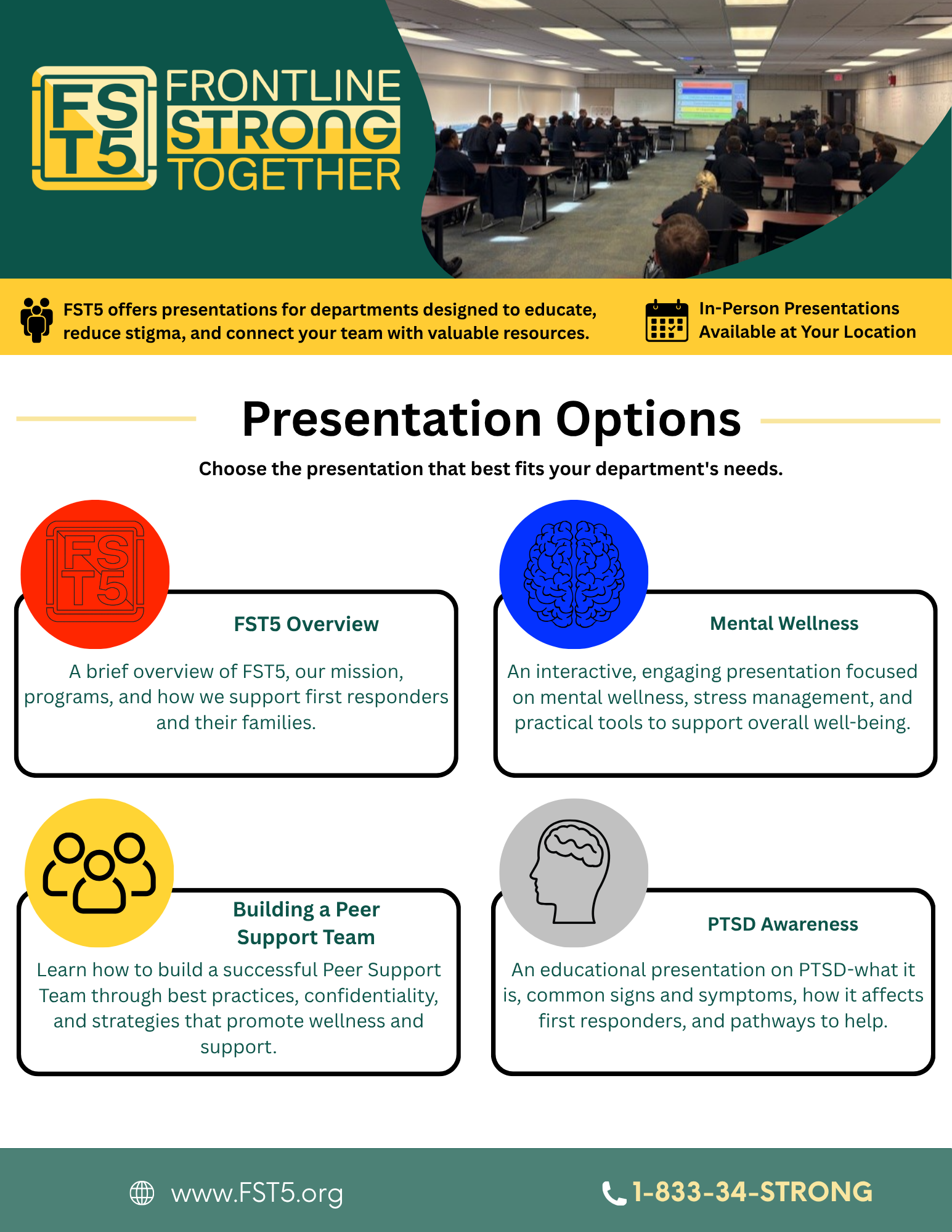
Training Overview

FST5 Department Wellness & Education Training provides practical, engaging education designed specifically for first responder agencies.

Choose from a variety of training topics focused on strengthening department wellness, reducing stigma, increasing awareness, and connecting first responders with practical tools and resources that support long-term personal and professional well-being.

Each training can be tailored to meet your department’s needs and is delivered in person at your location

Department Training Options

1. FST5 Overview

A brief overview of FST5, our mission, programs, and how we support first responders and their families.

2. Mental Wellness

An interactive, engaging presentation focused on mental wellness, stress management, and practical tools to support overall well-being.

3. PTSD Awareness

An educational presentation on PTSD-what it is, common signs and symptoms, how it affects first responders, and pathways to help.

4. Building a Peer Support Team

Learn how to build a successful Peer Support Team through best practices, confidentiality, and strategies that promote wellness and support.

Training Details

Format: In Person

Duration: 20–60 Minutes

Availability: Scheduled at Your Department’s Convenience

Why Departments Choose FST5

Departments choose FST5 training to:

  • Increase Mental Health Awareness
  • Reduce Stigma
  • Strengthen Peer Support
  • Improve Department Wellness
  • Connect Personnel with Valuable Resources
  • Promote Resilience Across the Organization

Schedule This Training

Click below to request this free training.

Zero to 60: Career Survival & Emotional Wellness


Hosted by Two The Rescue, LLC in partnership with Frontline Strong Together (FST5)

Training Overview

Join seasoned first responder Mike and his spouse, Anna, as they provide frontline insight into the importance of understanding hypervigilance and why it keeps you safe on calls for service, but also how it affects first responder health, relationships, and mental resilience.

Mike and Anna illustrate how unmanaged adrenaline and trauma exposure can compromise safety, decision-making, and communication with family, friends, and loved ones. This session equips participants with practical tools to manage the distinct stressors faced by first responders.

Gain practical knowledge from a fellow first responder and their spouse on effective methods to promote healthy relationships within the department, with first responder peers, and at home.

Key Topics

  • Stepping Off the Adrenaline Roller Coaster
  • The “Triangle of Success”
  • Managing Critical Incident Stress and Cumulative Stress
  • Recognizing Post-Traumatic Stress
  • Recognizing Suicidal Behavior
  • The 4 C’s for Survival
  • Support Strategies, Keys, and Phrases
  • CISM and Peer Team Resources
  • Spouses and Family Resources

Who Should Attend?

This program is designed for:

  • Fire
  • EMS
  • Law Enforcement
  • Dispatch
  • First Responder Loved Ones

Continuing Education Credits

  • 3 Michigan Pre-Approved Standardized EMS Credits
  • MFFTC Approved Training Course
  • MCOLES CPE Approved Credits
  • Dispatcher SNC Approved Credits

Scheduling and Cost

This training can be hosted by your department for all area first responders, including Fire, EMS, Dispatch, Law Enforcement, and their loved ones.

Date, Time, and Location are determined based on your department’s scheduling needs.

There are no out-of-pocket costs for your agency to host this training unless you choose to pay personnel for attending.

This training is supported through grant funding awarded to the Wayne State University Frontline Strong Together (FST5) Team. A meal is provided for attendees and their guests.

What Participants Are Saying

“If I would have known that this is what was going to be presented, I would have brought my spouse.”

“You and Mike are saving lives, saving relationships and preventing substance abuse with every presentation. Every public safety employee should attend this valuable training.”

“Very realistic and it hit close to home. This is the best training class I have ever attended.”

“A great chance to take time and internally reflect on how we need to continually remind ourselves that our emotional well-being is just as important to our survival as maintaining our tactical skills.”

Schedule This Training

Interested in bringing Zero to 60: Career Survival & Emotional Wellness to your department?

Click below to request this free training.
CISM: Assisting Individuals in Crisis and Group Crisis Intervention Training

CISM Training Requirement: Coordinator verification letter required prior to confirmation. Please see details below.


Course Description

This 3-day course combines ALL of the content of ICISF’s Assisting Individuals in Crisis & Group Crisis Intervention courses. Crisis Intervention is NOT psychotherapy; rather, it is a specialized acute emergency mental health intervention which requires specialized training. As physical first aid is to surgery, crisis intervention is to psychotherapy. Thus, crisis intervention is sometimes called “emotional first aid”. Designed to present the core elements of a comprehensive, systematic and multi-component crisis intervention curriculum, this course will prepare participants to understand a wide range of crisis intervention services for both the individual and for groups. Fundamentals of Critical Incident Stress Management (CISM) will be outlined, and participants will leave with the knowledge and tools to provide several group crisis interventions, specifically demobilizations, defusing and the Critical Incident Stress Debriefing (CISD). The need for appropriate follow-up services and referrals, when necessary, will also be discussed.

Registration Information

Participant Criteria: Michigan First Responders in the fields of Police, Fire, EMS, 911 Dispatch, Corrections as well as Mental Health Professionals.

Cost: Free

CISM Training Requirement:

Due to updated grant guidelines, all participants are required to provide a letter from an MCRA-accredited CISM Team Coordinator confirming that this training is necessary for the participant’s involvement or participation on a CISM team.

Grant funding cannot be applied toward training costs for participants who fail to provide the required documentation. Please submit the letter to [email protected].


Program Highlights

  • Psychological crisis and psychological crisis intervention
  • Resistance, resiliency, recovery continuum
  • Critical incident stress management
  • Evidence-based practice
  • Basic crisis communication techniques
  • Common psychological and behavioral crisis reactions
  • Putative and empirically derived mechanisms
  • SAFER-Revised model
  • Suicide intervention
  • Relevant research findings
  • Large group crisis interventions
  • Small group crisis interventions
  • Adverse outcome associated with crisis intervention
  • Critical Incident Stress Debriefing (CISD)

Learning Objectives

  1. Understand the natures & definitions of a psychological crisis and psychological crisis intervention.
  2. Understand key issues and findings of evidence-based, and evidence-informed practice as it relates to psychological crisis intervention.
  3. Understand the resistance, resiliency, recovery continuum.
  4. Understand the nature and definition of critical incident stress management and its role as a continuum of care.
  5. Practice basic crisis communication techniques.
  6. Be familiar with common psychological and behavioral crisis reactions, including empirically derived predictors of posttraumatic stress disorder. Assisting Individuals in Crisis and Group Crisis Intervention Training
  7. Understand the putative and empirically derived mechanisms of action in psychological crisis intervention.
  8. Understand and discuss the risks of iatrogenic “harm” associated with psychological crisis intervention and will further discuss how to reduce those risks.
  9. Understand how the SAFER-Revised model may be altered for suicide intervention.
  10. Understand and discuss the risks of iatrogenic “harm” associated with psychological crisis intervention and will further discuss how to reduce those risks.
  11. Understand and discuss the ethical implications, risks and obligations of providing group and individual crisis response services
  12. Define key crisis terms such as “critical incident,” “crisis,” and “crisis intervention.”
  13. Define key stress management terms such as “stress,” traumatic stress,” and “Critical Incident Stress Management (CISM).”
  14. Explain role of the comprehensive, integrated, systematic, and multi-component crisis intervention system, known as “Critical Incident Stress Management (CISM).
  15. Understand the nature of “resistance,” “resiliency,” and “recovery” in the field of CISM.
  16. List components of a CISM program to conduct group crisis intervention sessions.
  17. Briefly describe the five elements of CISM’s strategic planning formula.
  18. Explain the differences between informational and interactive group crisis intervention procedures.
  19. Practice by participation in role-play scenarios, the Informational Group Crisis Interventions such as:
    • Rest, Information, and Transition Services (RITS)
    • Crisis Management Briefing (CMB).
  20. Practice by participation in role-play scenarios, the Interactive Group Crisis Intervention such as:
    • Debriefing
    • Critical Incident Stress Debriefing (CISD).