Description: This webinar presentation explores first responder suicide data at the national and Michigan levels, how that data is collected and validated, and why accurate reporting matters. It also offers practical guidance for departments navigating reporting and decision-making after the loss of a member, with space for questions and discussion throughout.
Presenter Info: Jeff Dill, MA is a retired fire captain and the founder of the Firefighter Behavioral Health Alliance. He is nationally recognized for tracking and validating first responder suicide data and for advancing behavioral health awareness, accurate reporting, and suicide prevention across the fire, EMS, and dispatch communities. This presentation will also feature FST5 representatives and peers.
Continuing Education (CE) Credits: This event is approved for 1.5 Preparatory EMS CE credit through the MDHHS BETP. CE credits are NOT currently approved for Fire, Law Enforcement, Corrections, or 911 Dispatch. FST5 is actively working to expand CE approval to all frontline disciplines for future events.
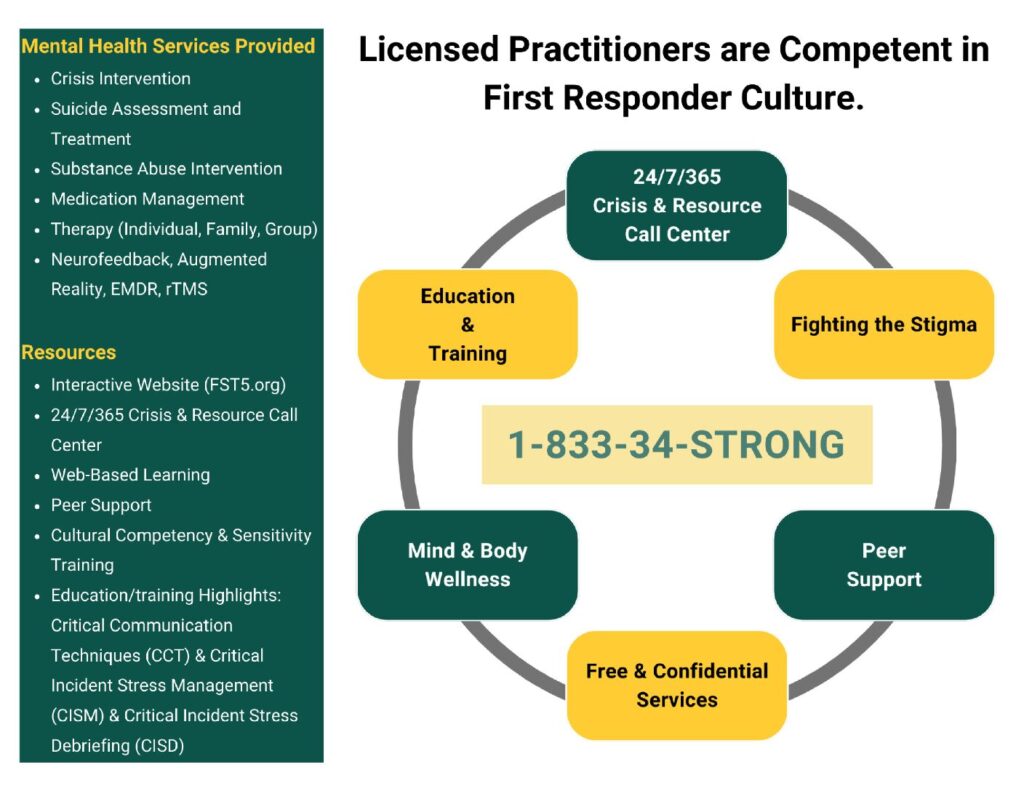
Description: This session provides an overview of the mental health, peer support, and wellness resources available through FST5 for first responders and their families. It focuses on how to access services, what to expect, and how departments can connect members to support.
Continuing Education (CE) Credits: This event is approved for 1 Preparatory EMS CE credit through the MDHHS BETP. CE credits are NOT currently approved for Fire, Law Enforcement, Corrections, or 911 Dispatch. FST5 is actively working to expand CE approval to all frontline disciplines for future events.
🗂️ Format: Virtual 🕧 Duration: 3 days 📅 Dates: ➥ Feb. 13th, 20th & 27th ➥ May 1st, 8th & 15th ➥ Aug. 5th, 6th & 7th
Course Description:
This 3-day course combines ALL of the content of ICISF’s Assisting Individuals in Crisis & Group Crisis Intervention courses. Crisis Intervention is NOT psychotherapy; rather, it is a specialized acute emergency mental health intervention which requires specialized training. As physical first aid is to surgery, crisis intervention is to psychotherapy. Thus, crisis intervention is sometimes called “emotional first aid”. Designed to present the core elements of a comprehensive, systematic and multi-component crisis intervention curriculum, this course will prepare participants to understand a wide range of crisis intervention services for both the individual and for groups. Fundamentals of Critical Incident Stress Management (CISM) will be outlined, and participants will leave with the knowledge and tools to provide several group crisis interventions, specifically demobilizations, defusing and the Critical Incident Stress Debriefing (CISD). The need for appropriate follow-up services and referrals, when necessary, will also be discussed.
Details:
Who:
Michigan First Responders in the fields of Police, Fire, EMS, 911 Dispatch, Corrections as well as Mental Health Professionals.
Format:
Virtual — click the registration button below for details.
Psychological crisis and psychological crisis intervention
Resistance, resiliency, recovery continuum
Critical incident stress management
Evidence-based practice
Basic crisis communication techniques
Common psychological and behavioral crisis reactions
Putative and empirically derived mechanisms
SAFER-Revised model
Suicide intervention
Relevant research findings
Large group crisis interventions
Small group crisis interventions
Adverse outcome associated with crisis intervention
Critical Incident Stress Debriefing (CISD)
Objectives:
Understand the natures & definitions of a psychological crisis and psychological crisis intervention.
Understand key issues and findings of evidence-based, and evidence-informed practice as it relates to psychological crisis intervention.
Understand the resistance, resiliency, recovery continuum.
Understand the nature and definition of critical incident stress management and its role as a continuum of care.
Practice basic crisis communication techniques.
Be familiar with common psychological and behavioral crisis reactions, including empirically derived predictors of posttraumatic stress disorder. Assisting Individuals in Crisis and Group Crisis Intervention Training
Understand the putative and empirically derived mechanisms of action in psychological crisis intervention.
Understand and discuss the risks of iatrogenic “harm” associated with psychological crisis intervention and will further discuss how to reduce those risks.
Understand how the SAFER-Revised model may be altered for suicide intervention.
Understand and discuss the risks of iatrogenic “harm” associated with psychological crisis intervention and will further discuss how to reduce those risks.
Understand and discuss the ethical implications, risks and obligations of providing group and individual crisis response services
Define key crisis terms such as “critical incident,” “crisis,” and “crisis intervention.”
Define key stress management terms such as “stress,” traumatic stress,” and “Critical Incident Stress Management (CISM).”
Explain role of the comprehensive, integrated, systematic, and multi-component crisis intervention system, known as “Critical Incident Stress Management (CISM).
Understand the nature of “resistance,” “resiliency,” and “recovery” in the field of CISM.
List components of a CISM program to conduct group crisis intervention sessions.
Briefly describe the five elements of CISM’s strategic planning formula.
Explain the differences between informational and interactive group crisis intervention procedures.
Practice by participation in role-play scenarios, the Informational Group Crisis Interventions such as:
Rest, Information, and Transition Services (RITS)
Crisis Management Briefing (CMB).
Practice by participation in role-play scenarios, the Interactive Group Crisis Intervention such as:
🗂️Format: Video lecture / discussion 🕧Duration: 60 minutes
Course Description:
This course explores how grief impacts first responders after traumatic loss, including suicide. Dr. Ali Amirsadri, Chief Medical Officer at Wayne State University’s Department of Psychiatry, joins FST5 peers to discuss emotional and physiological reactions to grief, how to identify complicated grief, and how to support peers, children, and families through loss.
Key Takeaways: ‣ Recognize signs of complicated grief ‣ Support peers and families coping with trauma ‣ Understand how suicide impacts individuals and departments ‣ Build empathy and resilience in high-stress environments
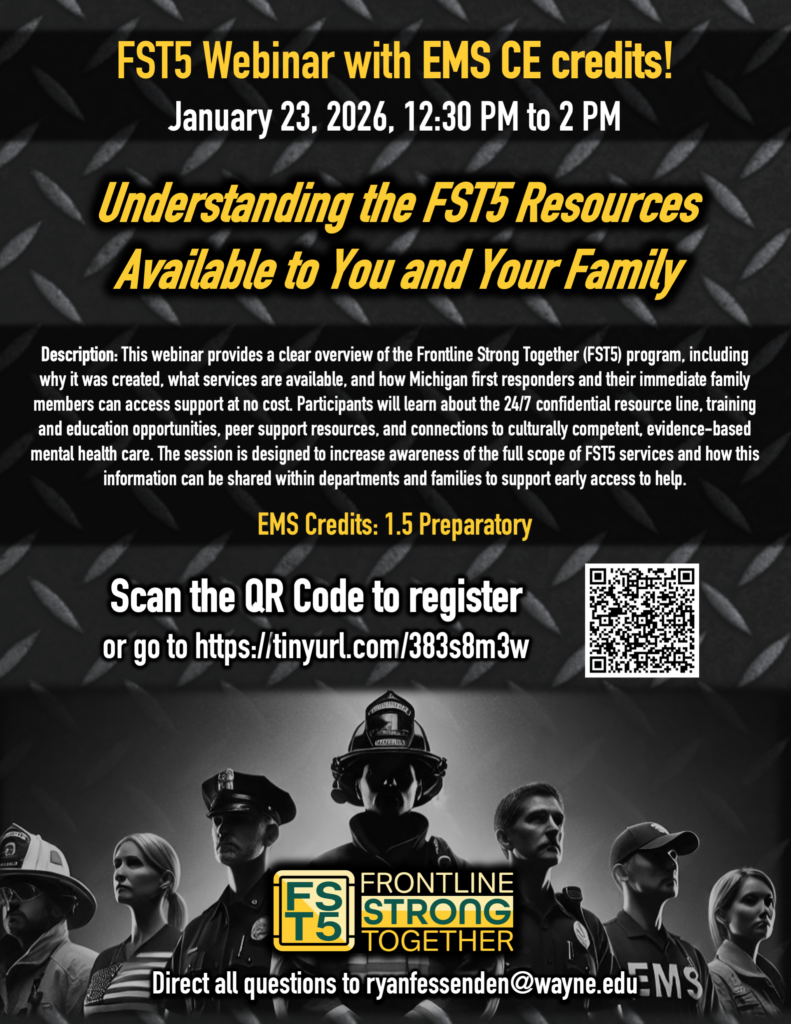
Description: This webinar provides a clear and practical overview of the Frontline Strong Together 5 (FST5) program. Participants will learn why the program was created, what services are available, and how Michigan first responders and their immediate family members can access support at no cost. The session is designed to help EMS providers and other first responders understand how to share and integrate FST5 resources within their departments and families to support early access to help.
Developed by experienced first responders and trauma-informed clinicians, this interactive course provides practical strategies for early intervention, peer connection, and handling acute stress reactions in the field. Participants learn to identify crisis warning signs, de-escalate emotional distress, and connect peers to professional support.
Key Takeaways: ‣ Identify and respond to signs of acute stress ‣ Apply practical peer support and listening skills ‣ Promote early intervention and psychological safety
A powerful and honest roundtable discussion focused on one of the most critical topics facing first responders today — suicide. These events bring together retired and active first responders to share real experiences, real perspectives, and real solutions in understanding and preventing this devastating tragedy — suicide, a painful reality in the lives of first responders. No filters. No judgment. Just an open, raw, and necessary conversation about the challenges we face and the paths toward healing and hope.
A powerful and honest roundtable discussion focused on one of the most critical topics facing first responders today — suicide. These events bring together retired and active first responders to share real experiences, real perspectives, and real solutions in understanding and preventing this devastating tragedy — suicide, a painful reality in the lives of first responders. No filters. No judgment. Just an open, raw, and necessary conversation about the challenges we face and the paths toward healing and hope.
Join us for a powerful webinar with Lynnette Fritshaw, a retired Acting Captain and the first and only career female firefighter in her department. After nearly two decades of suffering in silence, Lynnette is speaking out about the workplace psychological injuries caused by bullying, discrimination, harassment, and misogyny in the fire service. As a trauma coach, CISM instructor, and crisis interventionist, she will share her personal journey, expert insights, and practical strategies to help first responders recognize, process, and heal from workplace trauma.
It’s spring and you’ve probably noticed a change in when the Sun rises and sets. But have you also noticed a change in your mood?
We’ve known for a while that light plays a role in our wellbeing. Many of us tend to feel more positive when spring returns.
But for others, big changes in light, such as at the start of spring, can be tough. And for many, bright light at night can be a problem. Here’s what’s going on.
Every day, first responders face moments that leave a lasting impact. Our webinar, “Coming Home After a Tragedy,” is here to help you manage the emotional toll, build resilience, and find support in a community that understands.
First Responders can maintain work-life balance with the right strategies and outlook
First Responders play a vital role in ensuring the safety and well-being of our communities. Their schedules are demanding, often involving long shifts and unpredictable hours. In today’s world, it can be challenging to find and maintain a healthy work/life balance no matter the occupation. Managing a first responder schedule present even more obstacles (especially during the holidays) but, with the right plan of action and mindset, it’s possible to maintain a healthy work-life balance and excel in this critical profession.
Click the link below to read the 10 recommended tips by The Shelter Foundation:
Dr. Griffin, now an Assistant Fire Chief and a recognized voice in organizational leadership, shares his profound journey from front-line firefighting to influential leadership roles. With a focus on personal mission and resilience, he discusses his evolution through the ranks, his academic achievements, and his passion for teaching and advocacy. Dr. Griffin emphasizes the importance of a supportive community and learning from experiences, urging every professional to live and lead with a mission.